
Documents in Grenada Deed Records
The Chancery Clerk's office in Grenada County records two broad kinds of instruments. These are the ones that transfer land and the ones that burden it. A deed names the grantor and grantee and spells out the interest conveyed. A deed of trust works differently. It secures a debt rather than moving everyday ownership to a buyer. Treat releases, substitutions, liens, and notices as separate later events. Each has its own place in the chain.
| Deed Type | What It Does | Common Use |
|---|---|---|
| Warranty deed | Conveys the stated interest with title promises written in the instrument | An ordinary purchase and sale |
| Quitclaim deed | Conveys whatever interest the grantor has, without broad title warranties | Family transfers or curing a possible claim |
| Trustee's deed | Documents a conveyance made by a trustee under stated authority | Trust administration or foreclosure |
| Executor or administrator deed | Conveys estate land under probate authority | An estate sale |
| Tax deed | Documents a tax-sale or forfeiture-related transfer | Delinquent-tax land |
Plenty of other indexed records can touch the same parcel. Easements, rights-of-way, restrictive covenants, plats, and construction liens all appear in the deed records. Federal tax liens, civil judgments, lis pendens, assignments, and releases appear there too. A lis pendens deserves special care. It signals that a lawsuit may affect the land. Even so, it decides nothing about who owns it.
Grenada Chancery Clerk Holds Deeds
The Grenada County Chancery Clerk land-record office sits at 59 Green Street, Suite 1, Grenada, Mississippi 38901. Mail goes to P.O. Box 1208, Grenada, MS 38902. The phone line is 662-226-1821, and email reaches the office at jhayward@grenadacountyms.org. Counter hours run 8:00 a.m. to 5:00 p.m., Monday through Friday.
The office listing names its full index set. It includes the General Index to Deeds, General Index to Deeds of Trust, General Index to Substitutions, Sectional Index, Map/Plat Book, Lis Pendens Record, construction-liens record, federal tax liens, federal civil judgments, Chancery docket, Board minutes, and Will Book. That inventory is the road map for deed records research.
The county publishes no public online land-record index. Call before you travel. Ask whether a public terminal exists. Ask whether images can be viewed there, and how archived books get pulled. Do not assume remote deed images or any particular digital cutoff.
Walk Grenada's Grantor-Grantee Chain
A grantor gives up an interest. A grantee takes it. Put in order, those transfers form the chain of title, and the strongest chains start with the newest reliable owner plus one exact legal description. Names alone invite trouble, because people, estates, and entities often share nearly identical labels in Grenada County deed records.
- Use the Grenada County property search to capture the assessed owner, parcel key, legal description, and any deed book/page.
- Find that owner's acquisition deed with the owner listed as grantee. Match the legal description, not just the name.
- Read the grantor and any prior-instrument reference in that deed. Record dates, book/page, and instrument type.
- Search the former grantor as a grantee in an older period. Repeat while the property description remains consistent.
- Move to the sectional index, plat, paper book, microfilm, or archive source when the name index stops.
- Grantor
- The party that transfers the stated interest.
- Grantee
- The party that receives the stated interest.
- Chain of title
- The linked sequence of recorded transfers for the same land.
- Book and page
- The volume and page reference used to retrieve a filed instrument.
Use Grenada's Sectional Land Index
For rural Grenada County property records, an owner's name is not always the best entry point. Acreage is often indexed by Section, Township, and Range instead. Property Link gives separate fields for all three. The GIS example pairs the text “PT S1/2 NE1/4” with a local numeric reference.
Carry that legal text to the clerk's Sectional Index. Compare acreage, adjoining calls, deed book and page, and the grantor-grantee names side by side. Resist converting the text into a guessed parcel-number pattern. The parcel field accepts free text, and the county uses no single countywide display format.
A rural parcel may show a blank or zero street number. That tells you nothing about missing deed records. Search by PPIN, survey location, or legal description instead.
Join Grenada Deeds to Plat Books
A plat is a recorded drawing of lots, blocks, streets, easements, or an entire subdivision. The GIS fields SUB_NAME and SUB_NUM can point a records request straight to the Chancery Clerk's Map/Plat Book. Urban land calls for comparing lot and block language. A rural tract calls for the section or quarter-section text.
Tax-map lines help you find land, but they cannot replace the plat or survey. A modern parcel may merge older lots. It may also reflect a split recorded long after the first plat. If the current geometry disagrees with the deed, ask the clerk for replats, vacations, lot combinations, and easements.
Note: A recorded survey or plat carries a legal weight a tax-reference polygon does not.
Older Grenada Deed Book Paths
Grenada County formed in 1870. That date alone proves nothing about when each deed series begins or ends. The clerk's books remain the starting point. Archive and library sources carry the older work. Move between them on evidence rather than assumption.
The Mississippi Department of Archives and History county-record finding aid identifies original county materials. It also supplies microfilm references. Mississippi State University Libraries lists Grenada Deed Book I. The same collection includes cemetery sources, local histories, and Polk city directories from 1966 and 1970. FamilySearch offers partial Mississippi wills-and-deeds coverage, though access and county completeness vary.
The MSU county genealogy guide details the library's Grenada holdings for deeper deed records digging.
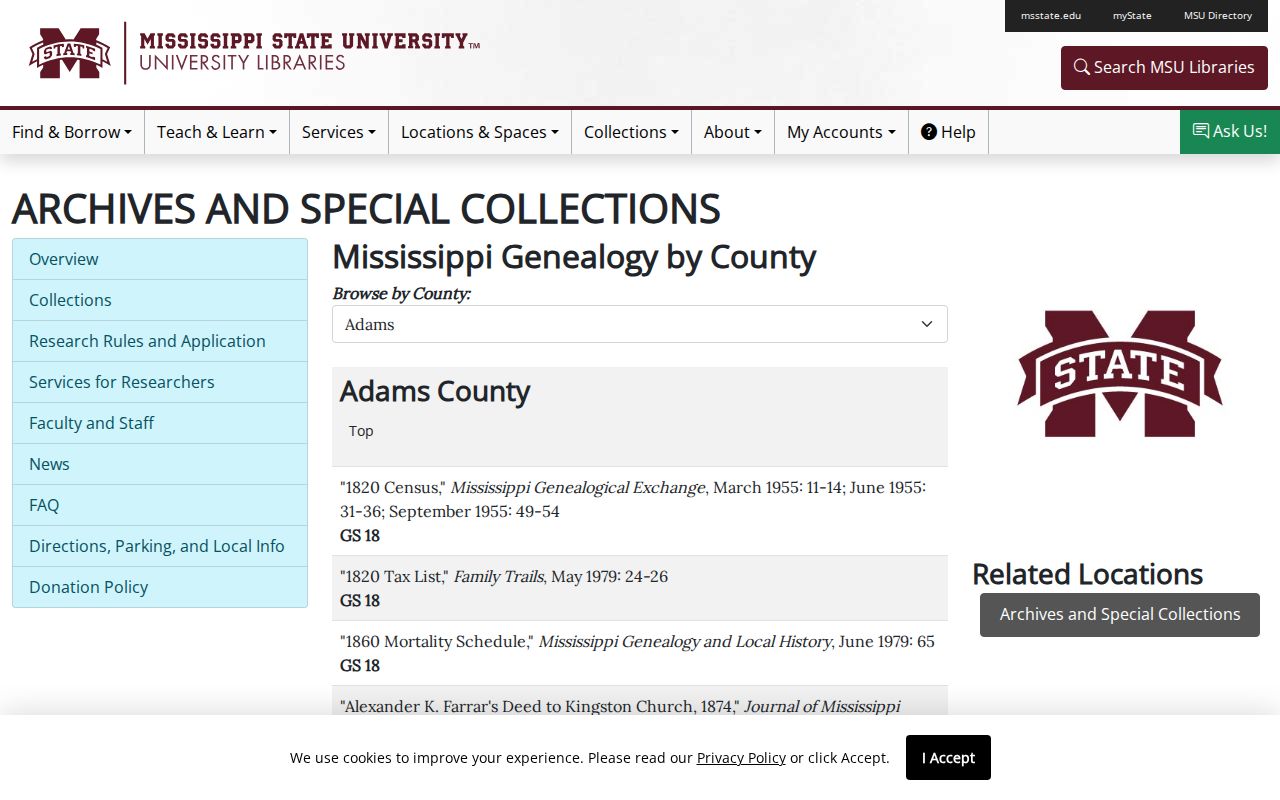
The finding aid is a map, not an index. Its collection clues shape the plan for an older-record search in Grenada County deed records, but the instrument itself must be verified with the custodian before you cite it.
City directories can bridge an old street address to an occupant. They do not prove ownership. Use the address to find the tax or deed entry, then cite that instrument.
Note: Directories locate people, not title.
Probate Can Redirect Grenada Deeds
Death changes title as surely as a sale does. Search the Chancery Clerk's Will Book and estate docket alongside the deed index. An executor's deed can supply the next link in the chain. So can a court-approved sale, a partition, or a survivorship clause. A later heir conveyance works the same way.
Keep in mind that a will alone is not a deed. Match the probate order or executor authority to the recorded instrument and its legal description. The assessed owner can stay unchanged during estate administration. A tax roll mismatch does not mean the probate path failed.
Read Grenada Releases After Liens
A purchase or an estate deserves more than the acquisition deed. A deed of trust can be assigned to a new lender. A substitution can change the trustee. Neither event releases the debt. For that, search for a satisfaction, cancellation, release, partial release, foreclosure instrument, or court order.
Related indexes hold construction liens, judgments, lis pendens, easements, and covenants. Match each record to the land description. A statewide tax lien can cover all Mississippi property owned by a taxpayer. It may never name a single parcel. The Mississippi UCC search adds context when business fixtures are involved. It cannot replace Grenada deed records, though. Keep the land description as your anchor.
Trace Grenada's Railroad-Era Blocks
Historic Grenada deed records may describe downtown land through blocks and lots. Street frontage and railroad context also appear in the legal text. The commercial core grew around railroad and river commerce in the 1850s. Many surviving resources date from the late nineteenth and early twentieth centuries. Modern parcel geometry may not mirror the first recorded layout.
Start with the current deed book and page plus the parcel's legal text. Then compare earlier plats using these street names as address clues. They include Margin Street, Main Street, First Street, Green Street, Line Street, Doak Street, Third Street, Mound Street, and Bell Street. Historic district sources supply context, not proof of ownership.
A 1966 or 1970 Polk directory can tie an occupant to an address. That covers a pre-digital year. Confirm title for that year through the deed chain and assessment record. Occupancy and title are different facts.
Frame a Grenada Land Request
When travel is not practical, email or mail a focused request to the Chancery Clerk. State the parcel or PPIN, the full legal description, grantor and grantee variants, date range, document type, and any known book and page. Ask for the index entry and the instrument image. Also request associated plats, deeds of trust, assignments, releases, liens, lis pendens, or probate deeds.
The Mississippi Public Records Act lets a public body charge reasonable actual costs. These cover search, review, duplication, and mailing. Ask to inspect in person if cost matters. Request an estimate first. A custodian may need extra time for archived material or protected content.
If the office cannot locate the record, ask which index and date range were searched. Also ask whether the material transferred to MDAH. Keep that answer in your log.
Request a Grenada Deed Copy
The county publishes no public online deed-image service. Request access directly from the Chancery Clerk. Provide grantor and grantee, instrument type, recording date, book and page. Include the parcel or PPIN. Add the legal description. State whether you need inspection, a plain copy, or a certified copy. Ask for a fee estimate and delivery options before sending payment.
Official 2024 material lists $1 to certify a complete filed document. The copy costs $0.50 per page when a clerk makes it, and $0.25 per page when another person makes it. Recording charges and archive fees are separate. Confirm the current Grenada amount. A statute, local procedure, record size, or archive retrieval can change the total.
A focused written request can also invoke the Mississippi Public Records Act. Identify the custodian, the record, the date range, and the format you want. Ask whether the record is archived, exempt, sealed, or available at a public terminal.
Recorded, not guaranteed. The index shows filed instruments. It is not a title opinion, and unrecorded interests or unresolved defects may exist.