
Meaning of Grenada Property Values
Mississippi uses the assessor's full estimate as true value, and a statutory assessment ratio then converts that figure into assessed value for tax purposes. A deed's recorded sale price works differently. It proves one transaction happened, nothing more. Treating a reduced taxable figure as comparable to an asking price is a common slip, and separating these terms keeps Grenada County property values from being misread.
| Value Type | Meaning | Official Source |
|---|---|---|
| True value | Assessor estimate before the statutory ratio | County assessment roll |
| Assessed value | True value multiplied by the class ratio | County assessment roll |
| Last sale or consideration | Amount tied to one transfer, when stated | Recorded deed |
Dates and purposes rarely line up. A deed may carry unusual sale terms, while the assessor's appraisal follows mass-appraisal rules across the whole tax roll. Improvements can post after a transfer closes, and the public roll may lag courthouse activity, so match the parcel number and effective date before weighing any figures against each other.
Grenada Assessment Ratios
The Mississippi Department of Revenue states the formula plainly. It is true value times assessment ratio times millage. Class I covers single-family owner-occupied residential real estate at 10 percent of true value. Class II, other real property, sits at 15 percent. Class III personal property also carries 15 percent. Class IV public utility property takes 30 percent. Take a $100,000 true-value figure. It yields a $10,000 assessed value only if the parcel qualifies as Class I. That example is arithmetic, not a description of any Grenada parcel. Classification must come from the live roll. The millage side of the math belongs with Grenada County property tax records.
Look Up Grenada Assessed Value
The DeltaProperty Link form is the county's official entry point. It serves as the gateway for a Grenada County property search. It accepts a name, address, parcel number, Section/Township/Range, or PPIN. Read whatever labels the result card actually displays. Fields for land, improvements, totals, or sale data are not guaranteed to appear. So verify each parcel rather than assuming the layout.
- Search the situs address with the assessor's spelling and directional.
- Confirm parcel, PPIN, and legal description before reading a value.
- Record the year, class, true value, assessed value, and exemption fields shown.
- Check deed date, book/page, or sale data against the Chancery Clerk record.
- Assessed value
- The tax base after the class ratio.
- True value
- The assessor's estimate before that ratio.
- Assessment ratio
- The statutory class percentage.
- Sale consideration
- An amount tied to a recorded transfer, if stated.
- Reassessment
- An update to appraisal data; no Grenada cycle date was verified.
One caveat comes straight from the county tax-search landing page: uploads can lag behind courthouse activity.
So a recorded deed may not show up in the owner or value fields right away.
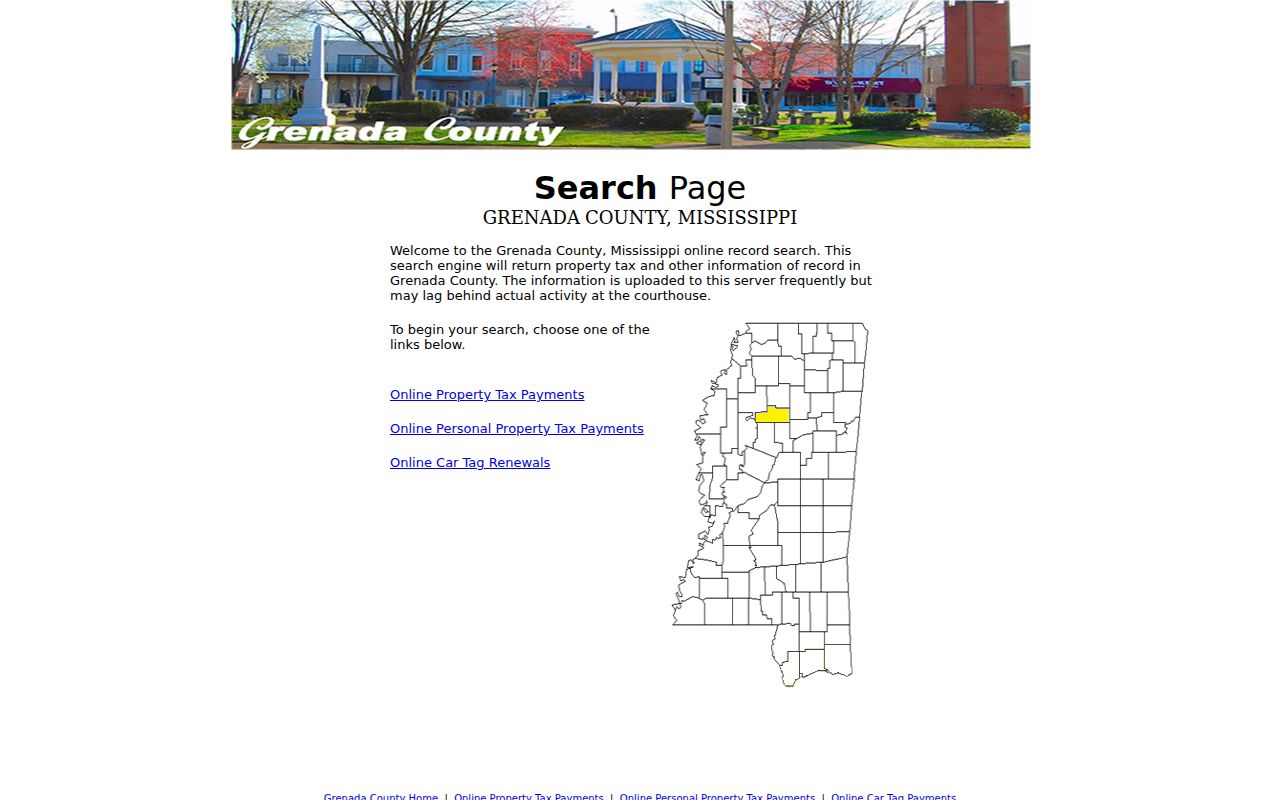
The official tax-search landing page lays out the county's online lookup route and carries its own timing warning. Any value that must be current should go through the Tax Assessor.
Read Grenada Homestead Signals
GIS maps and tax records sometimes flag a parcel with HOMESTEAD or EXEMPT_COD. Treat these as tax attributes, nothing more. They help explain why two similar Grenada County parcels carry different taxable exposure. Yet they cannot redefine true value or prove title.
Mississippi ties homestead treatment to ownership and primary-residence occupancy on January 1. Applications are handled by the Tax Assessor between January 1 and April 1. Plenty of life events can force a new filing. Ownership changes, a new legal description, a shift in use or occupancy, marriage, divorce, a death, a disability, or a change in veterans status all count. Note the exemption when comparing Grenada County property values side by side. Then confirm eligibility separately.
Note: Judge two assessments only within the same class and tax year.
Verify Grenada Sale Evidence
A last-sale label means little on its own. You need the same legal parcel and the recorded instrument behind it. Ask the Grenada County Chancery Clerk to pull the deed. Use the book and page or the grantee name. The clerk's directory lists no online land-record index. You may need the counter, a public terminal, a phone call, an email, or a written request to confirm the sale.
Not every deed reflects an ordinary market sale. Quitclaim deeds, family transfers, estate deeds, trustee deeds, and multi-parcel instruments often serve other purposes. Read the deed type, the date, the parties, the legal description, and the consideration language. One past amount never establishes present property value on its own.
Grenada's Historic Assessment Trail
The MDAH Grenada assessment series holds land and personal assessment material. It runs from 1870 through at least 1897. Land rolls survive for 1875, 1879, 1883, 1887, 1892, and 1896. Those rolls can pin down an older tax identity or owner. Their dollar amounts are not market comparisons today.
Pair the series with deeds, plats, and directories. That combination can follow a single tract across the decades. Grenada County history gains real depth from that paper trail. A historic assessment still cannot prove that today's parcel keeps the same boundary or value.
Grenada City Value Context
Grenada's downtown grew from Yalobusha River commerce and the railroad. Late-nineteenth and early-twentieth-century buildings survive in the documented historic district, and Margin, Main, First, and Line Streets carry added preservation context. That history shapes use and buyer interest. It is not a dollar adjustment.
County QuickFacts reports a median owner-occupied housing value of $132,200 for 2020 through 2024. A median describes a broad population. It sets no value for one city lot, downtown building, home, or rural tract in Grenada County. Credible sales matter most.
Question a Grenada Assessment
Start with the Grenada County Tax Assessor. Reach the office at 59 South Green Street, Room 6, or call 662-226-1741. Ask which year, class, land data, improvement data, and exemption status produced the figure. Then gather evidence: the notice, parcel printout, deed, photographs, appraisal, and comparable sales.
DOR rules say an owner disputing a local assessment normally requests a Board of Supervisors hearing by the first Monday in August. That deadline comes before the tax due date. Confirm the current deadline. The real task is naming the exact figure in dispute. It also means naming the evidence, not waving at a guess. Pointing to another online estimate is not enough. Vague appeals fail.
Limits of Grenada Property Values
Each number answers a different question. An assessed value is a statutory figure used for the tax roll. True value is the assessor's estimate of worth. A deed's sale amount, meanwhile, only records what changed hands on one past date. None of them can tell you about hidden defects, current condition, buyer demand, easements, private transfer terms, or exactly where a boundary sits. That last part is a question of land, not price.
For those answers, bring in the right professionals and records. A licensed appraiser can give an opinion of present market value. A surveyor can pin down boundary location. Deeds and plats remain the authoritative sources for land identity. Grenada County property values serve as official evidence within their stated purpose, year, and source. But they are never a guaranteed prediction of a sale.
Tax value is not a sale forecast. Grenada County assessed value serves taxation and may be higher or lower than a current market result.